Wood, carapace, iron
While working on Age of Frontiers, I've started making icons to give some shape to the world and its systems. This is how the equipment icons look right now (still work in progress). Each armour piece comes in light, medium and heavy versions, and in the three materials that matter: wood, carapace and iron:
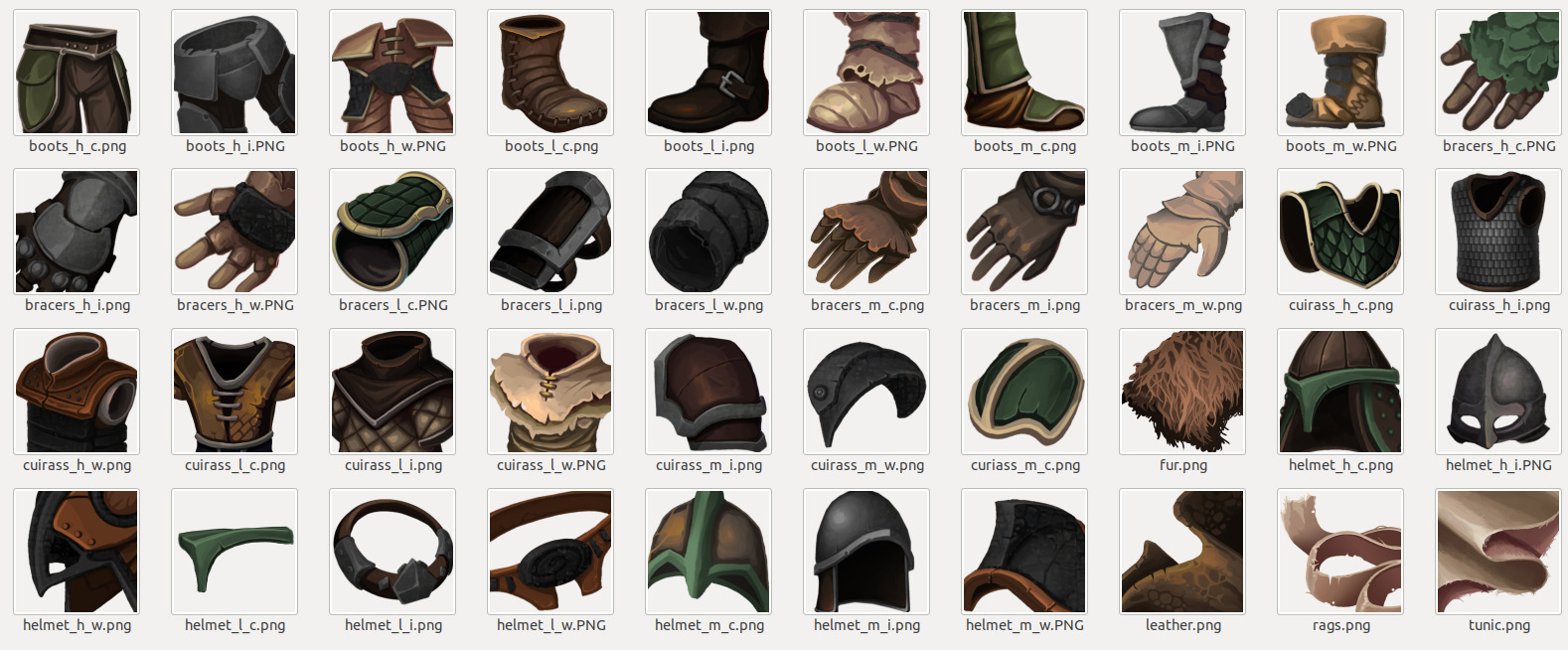
Which reminded me that there has never been a clear explanation of the materials people in Calima use for crafting (mostly weapons and armour in the games), even though they already appear in Slave Pits. Let's fix that!
Wood
The wood most commonly used in Calima comes from two trees: the most widespread evergreen, found at every latitude, and a deciduous kind from the south, more affected by the radiation. Their logs give off little heat when burnt, and a thick, bluish smoke that, conveniently, clears the fog over a wide radius around the fire.
If the surface is heated with enough time and care, the wood hardens into a fairly tough, light sheet that can be used to make tools, weapons and armour. Its quality depends a lot on the armourer's skill, but it is still the most common material for this kind of equipment.
Carapace
The name used for any material taken from the creatures of Calima to make tools, weapons and armour. The most common one, and the one that gave the term its name, is the bony scales of the kutsanp, but the bones and teeth of the vaghadata, the hooves and frontal growths of the kongniu and others are used too.
Harder than the ubiquitous wooden pieces, carapace is costlier to obtain and to work properly, and much more valued.
Iron
A fairly abundant ore in the most mountainous regions of Calima. Forging it is a poor craft: there are no fuels to reach high temperatures, the ore is full of impurities, and nobody has advanced knowledge of metallurgy. It is rumoured that some of Kur's followers know techniques to improve the quality of the iron, and the few masterwork pieces seen over the centuries seem to prove it.
Even so, and as brittle as its products usually are, iron tools, weapons and armour are still the best equipment available. The metal itself is valued so highly that it is even used as currency, in the form of coins or longer cylinders.
So next time you find a rusty iron helmet in Calima, treat it with respect: someone probably paid for it with the same metal.
Om